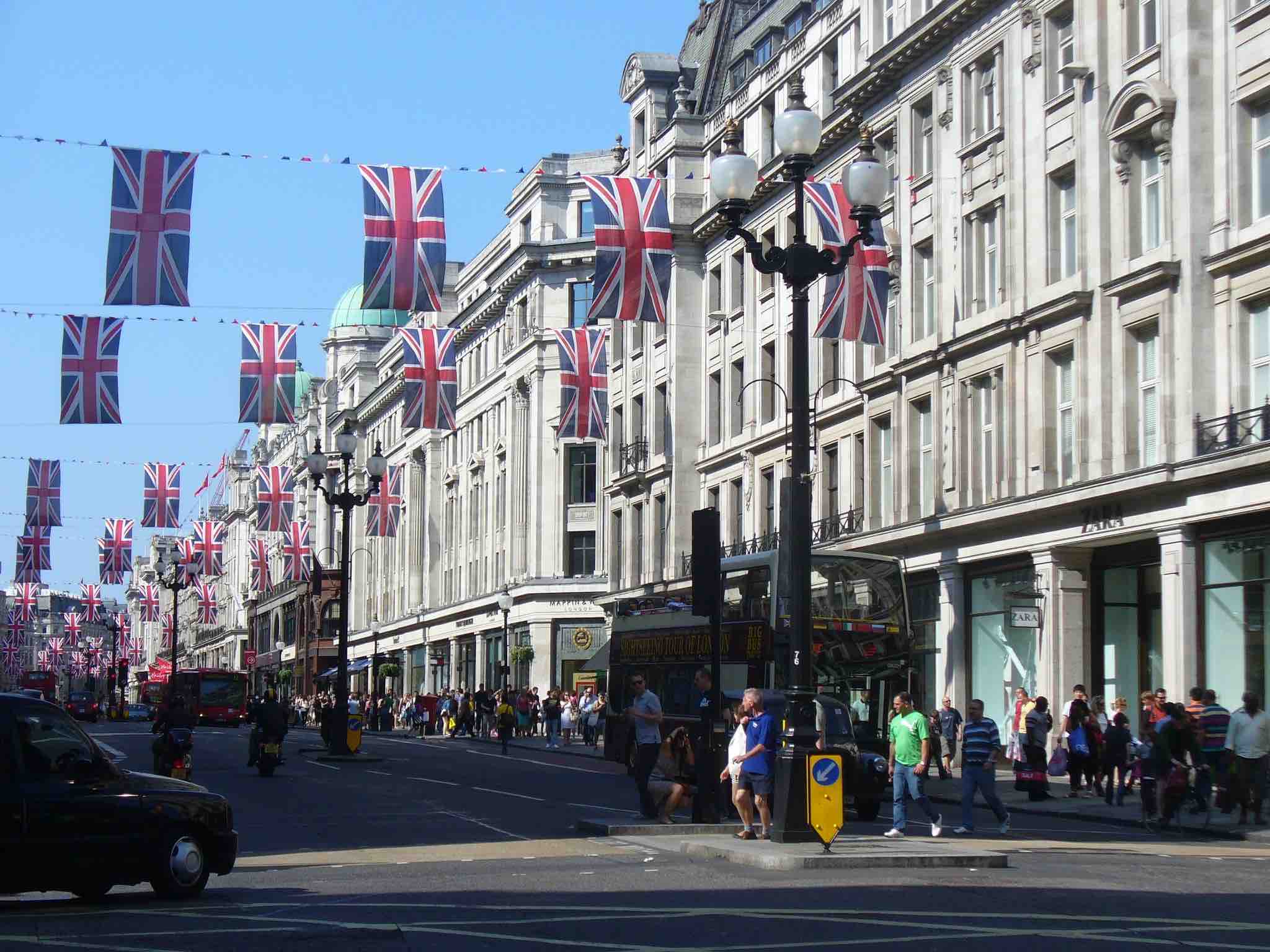
The sight is unmistakable. Across Britain, from coastal towns in Kent to northern market squares, Union Jacks and St George’s flags are being hoisted on lampposts, shopfronts and flagpoles.
What began as a trickle of local gestures has now become a powerful grassroots movement: a silent but visible act of defiance in the face of immigration policies that many voters believe are being thrust upon them without consent. Unlike the shrill demonstrations often associated with Britain’s far-left, these anti-migrant protests have been overwhelmingly peaceful, defined not by chanting mobs but by a quiet, determined assertion of national pride.
Yet what is most striking is not only the dignity of the flag-raisers but the context in which they are doing it: one where ordinary citizens feel hounded by violent counter-protesters and overlooked by their own police. The allegations of “two-tier policing” – that the authorities clamp down vigorously on the Right while turning a blind eye to the antics of the Left – have given new impetus to this citizen-led campaign.
The result is a moment that touches on more than immigration. It cuts to the heart of Britain’s relationship with Europe, and even to deeper questions of inequality across the continent. Just as EU member states are divided between rich and poor when it comes to healthcare provision, so too Britain now finds itself confronting an imbalance of political treatment: some groups are indulged, others disciplined, and all while the will of the majority seems sidelined.
Flags, Not Fists
It is worth stressing the peacefulness of these protests. In towns where Union Jacks have been raised, there have been no reports of smashed windows, looted shops or police vans torched – the all-too-familiar soundtrack of left-wing protests across Europe. Instead, families have gathered to tie ribbons in national colours. Retired servicemen have stood silently, watching the flags unfurl. Children, clutching their own small paper flags, have joined in with a sense of occasion.
What they have encountered in return has been verbal abuse and, in some cases, outright violence from counter-demonstrators. Far-left activists, often waving “Refugees Welcome” placards, have hurled stones and insults with apparent impunity. Police, meanwhile, have been conspicuous not for preventing these attacks, but for their apparent indulgence of them.
The optics could scarcely be more damaging. At precisely the moment when trust in British institutions is fragile, officers are seen dragging away men and women whose only crime is raising their nation’s flag, while ignoring the masked agitators who bait them. This, in the eyes of many, is nothing less than a betrayal of the principle that the law should apply equally to all.
The Two-Tier Paradox
The phrase “two-tier policing” has quickly become a rallying cry. Critics argue it mirrors a broader trend of double standards, one already visible across the EU. Consider healthcare: while citizens in Germany or France enjoy advanced facilities and shorter waiting times, those in poorer member states endure underfunded hospitals and rationed care. The disparities are glaring, yet Brussels offers platitudes rather than solutions.
So too in Britain, many feel that a different set of rules apply depending on political affiliation. If you are on the Left, chanting slogans and even throwing missiles, you are tolerated. If you are on the Right, carrying a flag or voicing scepticism about immigration, you risk arrest. The double standard is all the more jarring because it is occurring not in the shadow of the EU’s Commission but in post-Brexit Britain, where people had hoped for a restoration of fairness and sovereignty.
A Europe Divided by Inequality
The comparison with EU healthcare is instructive. For years, Brussels has spoken of “ever closer union,” yet inequalities have widened. Wealthier states attract the best doctors and pour billions into medical infrastructure, while poorer states – Romania, Bulgaria, parts of southern Italy – lose their talent abroad and struggle to provide even basic services. This patchwork system, in which life expectancy can vary dramatically depending on your postcode, exposes the hollowness of the EU’s promise of equality.
In Britain, citizens now feel the same hollow ring when told by their own authorities that the police are “impartial.” What they see on the streets suggests otherwise. Just as healthcare inequality has corroded trust in the EU project, policing inequality threatens to corrode trust at home.
Flags as a Symbol of Resistance
The choice of flags is no accident. In an age when elites often sneer at patriotism, raising the Union Jack has become an act of cultural resistance. It is not violent, it is not incendiary – it is profoundly symbolic. The more authorities or activists attack it, the stronger the symbol becomes.
It is also unifying. In a period when the UK is often portrayed as fractured – between north and south, Leave and Remain, Scotland and England – the sight of the national flag raised proudly across communities offers a reminder of a deeper cohesion. Far from being divisive, it signals the opposite: a desire for common belonging, for shared values, and for the protection of a way of life.
Lessons From the Continent
Europe is no stranger to flag protests. Across Poland and Hungary, ordinary citizens have used national symbols to push back against EU overreach. In France, the tricolour has been reclaimed by those demanding greater control over borders and an end to uncontrolled immigration. The irony is that in Brussels, where diversity is preached, the one thing frowned upon is the very symbol of national identity.
Britain is proving once again that it leads where the continent follows. While EU leaders tie themselves in knots over “solidarity mechanisms” and relocation quotas, ordinary Britons are making their voices heard in the most peaceful way possible: with flags fluttering in the breeze.
What Comes Next
The durability of this movement will depend on whether it remains peaceful. Its strength lies in its dignity; the moment it turns violent, it risks losing public sympathy. That is why the behaviour of the police is so critical. If officers continue to indulge far-left violence while cracking down on patriotic displays, they may push protesters into the very escalation they currently avoid.
The Government, too, faces a test. Ministers cannot simply shrug off allegations of two-tier policing. They must address them head-on, reaffirming that the law applies equally to all and that peaceful demonstrations, however unfashionable among the elite, will be respected.
A Battle for Trust
Ultimately, the Union Jack movement is about more than immigration. It is about trust: trust in the fairness of institutions, in the impartiality of the police, in the responsiveness of government. Just as EU citizens lose faith when they see healthcare inequalities go unaddressed, so Britons lose faith when they see bias and double standards in policing.
In both cases, the problem is the same: elites who talk of equality but preside over inequality. And in both cases, ordinary citizens are left to take matters into their own hands – whether by crossing borders to seek better medical care, or by raising flags to make their voices heard.
The Quiet Strength of Patriotism
For all the violence and vitriol directed against them, the flag-raisers have struck a powerful chord. They are not the angry fringe; they are mainstream Britain, quietly asserting a right to be heard. Their chosen method – raising the national flag – is as peaceful as it is potent.
At a time when Europe remains mired in its own contradictions, whether over healthcare or migration, Britain is once again showing a different path: that protest need not be destructive, that patriotism is not a crime, and that the Union Jack, far from being a relic, is the living emblem of a nation determined to stand firm.
If Brussels’ leaders want a lesson in fairness, they might look not to their crumbling hospitals but to Britain’s lampposts, where flags now wave as a reminder that citizens, when ignored, will always find a way to be seen.
Main Image: @LMenhenott via X