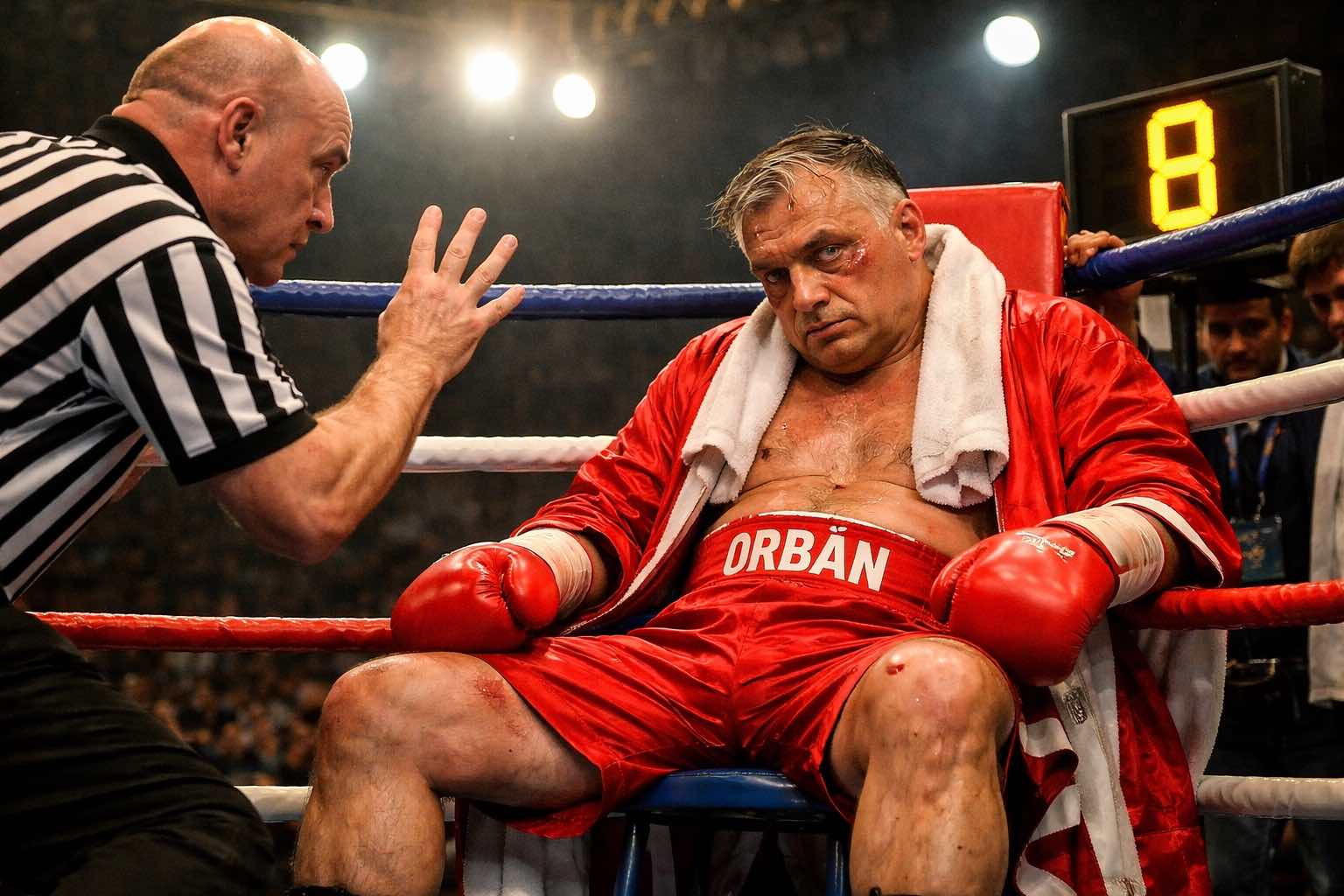
There are moments in politics when the façade cracks—when carefully curated power gives way to something raw, unpredictable, and telling. Viktor Orbán, once seemingly untouchable, has just experienced one such moment.
At a campaign rally in what has become increasingly fertile ground for opposition support, Orbán found himself on the defensive. As whistles and boos rang out, he lashed back, accusing protesters of “pushing Ukraine’s cart” and betraying Hungarian interests.
It was a striking image: a leader who has dominated Hungarian politics for more than a decade, suddenly rattled, visibly irritated, and increasingly out of sync with a portion of his own electorate. But more than that, it was a revealing glimpse into a campaign that is no longer under his control.
Because the truth is simple: this election is no longer about Viktor Orbán. It is about the man who has emerged to challenge him—Péter Magyar—and the growing sense that Hungary is ready to turn the page.
A Campaign Built on Fear Is Losing Its Grip
Orbán’s response to the Győr crowd was telling. Rather than engage with legitimate dissent, he defaulted to a familiar script: external enemies, foreign interference, and the ever-convenient spectre of Ukraine. By framing his critics as agents of another country, he attempted to delegitimise their concerns without addressing them.
But this tactic, once effective, has clearly lost its potency.
For years, Orbán has built a political machine rooted in division—Hungary versus Brussels, tradition versus liberalism, sovereignty versus interference. Now, with the war in Ukraine providing fresh material, he has leaned heavily into a narrative that paints the opposition as warmongers or puppets of foreign powers.
Yet voters are increasingly unconvinced. Economic stagnation, rising living costs, and frustration with corruption have shifted the conversation back to domestic realities.
In that context, shouting about Ukraine begins to sound less like leadership and more like deflection.
Enter Péter Magyar: A Credible Alternative
What makes this moment particularly significant is not just Orbán’s vulnerability—it is the credibility of his challenger.
Péter Magyar is not a fringe figure or a recycled opposition name. He is a former insider, someone who understands the machinery of power from within and has chosen to confront it. That alone gives him an authority that previous challengers have lacked.
More importantly, Magyar has tapped into something deeper: a widespread hunger for normalcy. Not revolution, not ideological upheaval, but a return to accountable governance, functional institutions, and a Hungary that works for its citizens rather than its elites.
His message is resonating. Polls indicate that his Tisza Party has not only closed the gap with Fidesz but, in many cases, overtaken it.
That is no small feat in a political system widely seen as tilted in Orbán’s favour.
The Power of Momentum
Momentum in politics is a powerful force, and right now, it belongs to Magyar.
Mass rallies, large-scale demonstrations, and a visibly energised base suggest that his campaign is not merely competitive—it is surging. Tens of thousands, even hundreds of thousands, have turned out for opposition events, signalling a level of engagement that Orbán’s camp has struggled to match.
By contrast, the prime minister’s rallies have begun to feel strained. The Győr incident is not an isolated embarrassment; it is symptomatic of a broader shift. Even in areas once considered strongholds, the mood is changing.
And when a leader starts arguing with his own audience, the writing is often on the wall.
A Question of Direction
At its core, this election is about direction.
Orbán offers continuity—a continuation of the same political style, the same international alignments, and the same confrontational approach to the European Union. His defenders see stability; his critics see stagnation and isolation.
Magyar offers something different. While not without his own complexities, he represents a reorientation: toward Europe, toward institutional reform, and toward a politics less defined by perpetual conflict.
That distinction matters, particularly for younger voters who have grown up under Orbán’s rule and are increasingly impatient for change.
It also matters for Hungary’s standing in Europe, where tensions over rule-of-law issues and foreign policy have left the country increasingly isolated.
The Desperation Factor
If Orbán’s rhetoric in Győr revealed anything, it is a sense of urgency—perhaps even desperation.
Accusing protesters of disloyalty, invoking foreign threats, and doubling down on divisive messaging are not the actions of a leader comfortably ahead. They are the tactics of someone who senses the ground shifting beneath him.
And the ground is shifting.
Even allegations of external interference and high-level controversies—such as claims about ties between Hungarian officials and Russia—have begun to shape the campaign narrative in ways that favour the opposition.
Magyar has seized on these issues, positioning himself as a defender of national integrity rather than a threat to it.
A Turning Point for Hungary
The Győr rally may, in hindsight, be remembered as a turning point—not because of what was said, but because of what it revealed.
A leader who once commanded unwavering loyalty is now being openly challenged. A political strategy built on fear is encountering diminishing returns. And an opposition figure once dismissed as an outsider is now leading a credible charge for power.
None of this guarantees victory. Orbán remains a formidable political operator, and the structural advantages of his system cannot be ignored.
But something fundamental has changed.
For the first time in years, the question is no longer whether Viktor Orbán can win. It is whether Hungary has already decided it wants someone else.
And judging by the voices heard in Győr, that answer may already be taking shape.
Click here for more News & Current Affairs at EU Today
Click here to check out EU TODAY’S SPORTS PAGE!
___________________________________________________________________________________________________________________
Viktor Orbán’s Isolation in Brussels Mirrors His Waning Support at Home