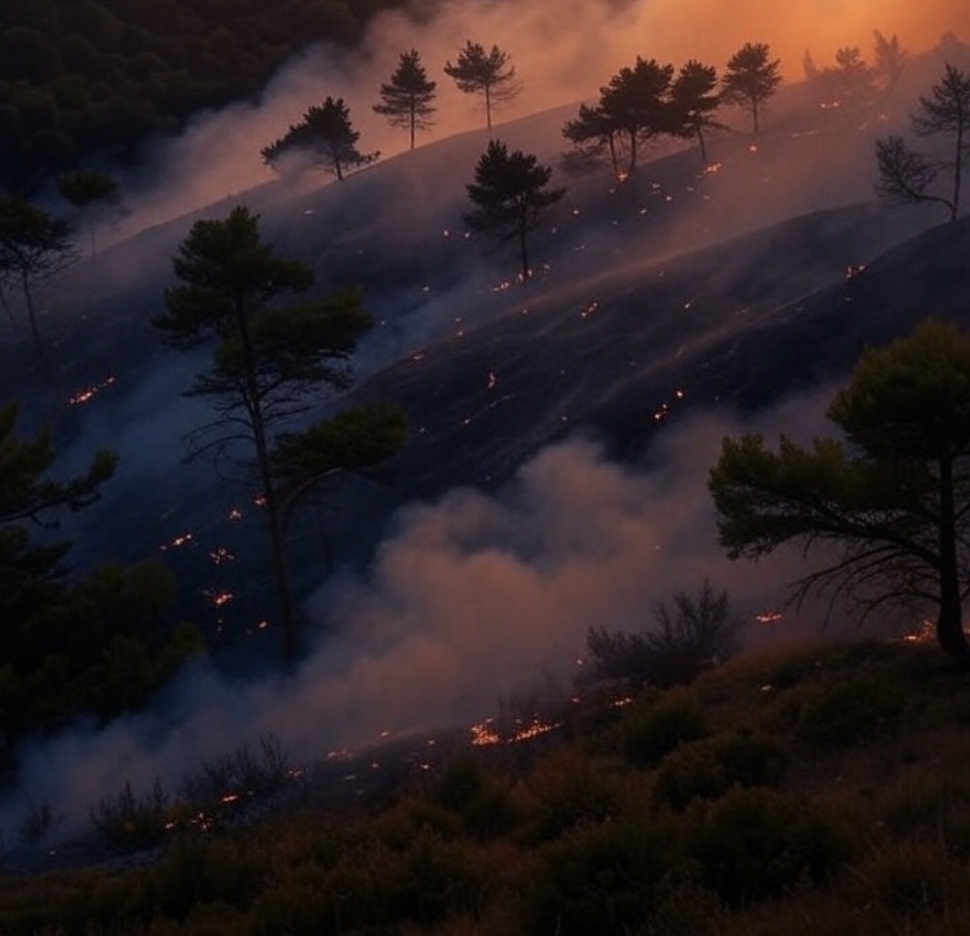
A wildfire on the outskirts of Athens was brought under control early on Saturday, but emergency crews remain on high alert as powerful winds threaten to reignite the flames and drive them into new areas. The reprieve, fire officials cautioned, is only temporary.
On Friday, much of the country had been ablaze. From the hills surrounding the capital to the olive groves of the Peloponnese, wildfires tore through towns and farmland, propelled by gale-force gusts that scattered burning embers across dry terrain.
The most severe outbreak erupted in Keratea, a small town to the southwest of Athens. Once the winds rose, the fire spread with terrifying speed, engulfing houses and sending residents fleeing. Firefighters later discovered the body of an elderly man inside a charred building, the first confirmed fatality of this latest wave of summer blazes.
By dawn on Saturday, the fire in Keratea had been “contained but not extinguished,” according to a fire brigade spokesperson. Water-bombing aircraft and helicopters hovered over the area throughout the morning, dousing hotspots in an effort to prevent flare-ups.
Evacuations Amid Uncertainty
Despite the apparent progress in Keratea, evacuation orders remained in place across several regions. The authorities warned that the forecast for the weekend offered no comfort — winds of up to 70 kilometres an hour were expected to whip through parts of Attica and the Peloponnese.
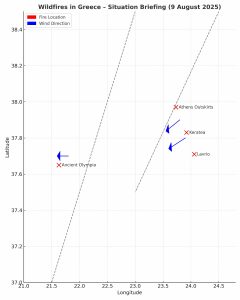
Villages near the historic site of Ancient Olympia, home to some of Greece’s most treasured archaeological remains, were also evacuated on Friday evening as flames advanced on the surrounding pine forests.
Locals watched smoke rise over the stadium where the Olympic Games were first held, fearing that the site might once again be threatened, as it was during the devastating fires of 2007.
In the Athens suburbs, residents in at-risk districts spent the night loading cars with whatever possessions they could carry — pets, photographs, a few changes of clothes — before heading for safer ground.
“I’ve seen this before, and you don’t wait to see if the wind changes,” said one woman from the coastal town of Lavrio, who drove her elderly parents to relatives in the city. “You leave while you can.”
A Country on Edge
The fires are the latest in a series of summer disasters that have pushed Greece’s emergency services to breaking point. Years of hotter, drier summers — widely linked to climate change — have left much of the countryside vulnerable to ignition from even the smallest spark.
Prime Minister Kyriakos Mitsotakis convened an emergency cabinet meeting late on Friday to assess the scale of the crisis. Officials said that while the worst of the immediate danger in Keratea had passed, they could not rule out further outbreaks over the weekend.
“The situation remains fluid,” a government spokesperson told reporters. “Our firefighters, civil protection forces and volunteers are engaged across multiple fronts, and every available aircraft is in the air.”
Economic and Environmental Toll
Early estimates suggest that dozens of homes and several thousand hectares of farmland have been destroyed since Friday morning. The economic losses for farmers, particularly in olive-growing regions, are expected to be severe.
Beyond the immediate damage, the environmental cost is likely to be long-lasting. Reforesting burned areas in Greece can take decades, and the destruction of pine forests in particular has knock-on effects for soil stability, biodiversity and local microclimates.
Ecologists warn that repeated fires in the same regions can leave the land unable to recover naturally, increasing the risk of desertification. “We’re not just losing trees,” said Dr. Eleni Papadopoulou, a forestry expert at the University of Thessaloniki. “We’re losing the capacity of these landscapes to support life.”
The Role of the Wind
Meteorologists have identified the wind patterns driving the fires as the key threat in the coming days. Known locally as “meltemi,” these strong northerly winds are a summer fixture in the Aegean, but in combination with prolonged drought they can transform a small grass fire into a raging inferno in minutes.
On Saturday, the Greek National Meteorological Service issued a red alert for high fire risk across much of the mainland and islands, urging residents to avoid outdoor activities that might create sparks, such as barbecuing or using power tools.
Calls for Better Preparedness
In recent years, Greece has made efforts to improve its wildfire response, increasing aerial firefighting capacity and setting up new coordination centres. But critics say these measures remain reactive, rather than preventive.
Opposition politicians and some local officials argue that more resources should be dedicated to clearing overgrown vegetation in high-risk zones and enforcing stricter building codes in rural areas.
“Every summer we see the same scenes — panic, destruction, loss — and then we go back to business as usual,” said the mayor of a small town in the Peloponnese. “We need to prepare in winter, not scramble in July.”
A Familiar Battle
For many Greeks, the images of burning hillsides and ash-filled skies are all too familiar. In 2018, a wildfire in the coastal resort of Mati claimed 104 lives in one of the deadliest fire disasters in modern European history. Since then, public awareness of the threat has grown, but so too has the sense that climate change is making such tragedies harder to prevent.
As the weekend unfolds, all eyes will remain on the wind. Fire crews are braced for flare-ups, and communities on the fringes of Athens and in rural districts are being told to stay vigilant and ready to evacuate at short notice.
For now, Keratea is breathing easier, but the smoke on the horizon is a reminder that in Greece’s long, dry summers, the danger is never truly gone.