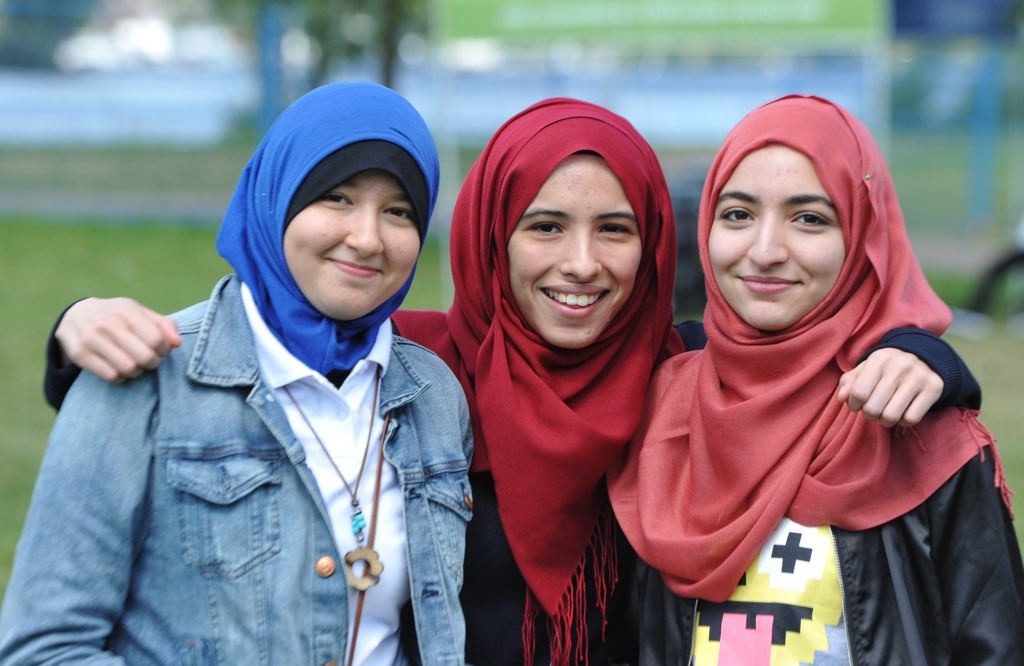
France’s latest foray into the fraught terrain of secularism and religious expression — a proposal to ban headscarves for girls under the age of fifteen in the classroom — has ignited a familiar firestorm.
Yet behind the predictable polemic lies a graver reality that the political class across Europe is struggling to confront: a deepening crisis in schools, where Islamist ideology is not merely a challenge to secular order, but an accelerating threat to the physical safety and cultural cohesion of the continent.
The proposed ban, currently being floated by President Emmanuel Macron’s centrist Renaissance party, is being sold as a defence of laïcité — France’s legally enshrined principle of secularism — and a necessary line in the sand against growing Islamist influence.
But the timing of the move is instructive. It comes just as the French government received an alarming internal report that the Muslim Brotherhood poses a “threat to national cohesion,” with particular emphasis on its recruitment and indoctrination efforts targeting schoolchildren.
This is not a theoretical concern. France has, in the past five years, become the tragic epicentre of jihadist-inspired violence within the educational system.
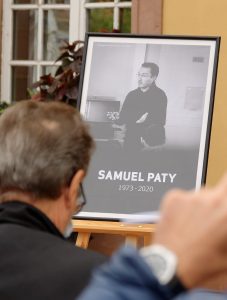
Image: By Sophie Barat – https://www.flickr.com/photos/135972066@N05/37019672366/, CC BY 2.0, https://commons.wikimedia.org/w/index.php?curid=62408976
The 2020 beheading of history teacher Samuel Paty outside his school in Conflans-Sainte-Honorine sent shockwaves not only through France but across Europe.
Paty was murdered for showing his students caricatures of the Prophet Mohammed during a lesson on free speech — a lesson that was both lawful and quintessentially French.
His killer was an 18-year-old Chechen refugee radicalised online, aided by a network of Islamist sympathisers who viewed the classroom as a battlefield for ideological control.
Since Paty’s murder, France has witnessed a string of further assaults on teachers, administrators, and even fellow students. In some cases, the perpetrators were not outside agitators but pupils themselves — teenagers radicalised through social media, home influences, and extremist preachers. The educational system has, in effect, become a frontline in what Macron has previously described as a fight against “Islamist separatism.”
The statistics are sobering. According to France’s Ministry of Education, there were over 1,900 reported cases of students challenging the values of the Republic in 2023 alone — from refusing to attend biology lessons due to perceived “immorality,” to threats against teachers who discuss secularism, gender equality, or the Holocaust. A growing number of teachers report self-censoring in the classroom for fear of retribution.
And the problem is not confined to France. In Germany, several states have reported an uptick in Islamist-linked intimidation in schools. In 2022, a Berlin teacher went into hiding after receiving death threats for showing a satirical cartoon during a civic education lesson. In Sweden, a teacher in Malmö was assaulted after discussing LGBTQ rights in class. Even the UK is not immune: Batley Grammar School in West Yorkshire found itself at the centre of a firestorm in 2021 when a teacher faced threats and had to go into hiding after showing images of the Prophet during a lesson.
These incidents are not isolated. They represent a systemic issue: the infiltration of radical Islamist ideologies into the educational environments of liberal democracies. Schools — once viewed as neutral spaces for the development of civic identity — are increasingly contested zones where the state’s authority is being tested and, at times, eroded.
The French government’s proposed headscarf ban for under-15s is therefore not merely a cultural flashpoint; it is an attempt, however flawed, to reassert control over a domain that is slipping from the Republic’s grasp. Supporters argue that girls below the age of majority cannot truly consent to veiling, and that such visible symbols of religiosity can serve as a gateway to ideological grooming. Critics, however, warn that the measure risks stigmatising Muslims further, alienating communities, and fuelling the very radicalisation it seeks to prevent.
Yet the broader question remains: what should European governments do when the values of liberal democracy are under siege within their own institutions?
It is no longer enough to speak vaguely of “integration” or to place the burden solely on the shoulders of underfunded teachers. A serious strategy must involve robust intelligence-sharing, the monitoring of foreign funding for mosques and Islamic schools, and, crucially, the empowerment of moderate Muslim voices who support the values of liberal education and the rule of law.
In this context, the Muslim Brotherhood looms large. Founded in Egypt in 1928, the Brotherhood has built an expansive network across Europe under the guise of civil society organisations. While not always directly involved in violence, its ideological influence — promoting an Islamist worldview incompatible with pluralistic democracy — has been well documented. In France, the Brotherhood’s affiliate organisations have embedded themselves within local community structures, charities, and education associations. Their influence is often subtle but corrosive, turning young minds against the Republic from within.
Macron’s government has already begun targeting these networks, with recent moves to dissolve Islamist-linked NGOs and tighten oversight over religious associations. But there is little appetite across the political spectrum for the deeper reckoning that is required — namely, a full-throated defence of Western values, and an acknowledgment that those values are worth protecting, even if it risks charges of Islamophobia.
In Britain, the debate remains heavily constrained by political correctness. The case of the Batley teacher exposed just how tepid official responses can be when multicultural pieties collide with liberal principles. Politicians equivocate, police tread gingerly, and media coverage too often prioritises “community sensitivity” over the security and moral clarity that educators need.
The tragedy is that these failures do not serve Muslim communities either. The vast majority of Muslim parents want their children to receive a good education in a safe environment. They do not want classrooms turned into ideological minefields or teachers living in fear. The greatest beneficiaries of a robust defence of secular education will be those very children whom radicals seek to exploit.
France’s headscarf debate, then, is a bellwether. It is not the answer, but a symptom — a response to a deeper cultural and security crisis that threatens the foundations of European liberalism. If democracies cannot protect their teachers, defend their classrooms, or uphold the values of open inquiry, then what hope is there for the next generation?
Europe must decide whether it still has the moral confidence to assert itself — not against a religion, but against a radical political ideology that cloaks itself in the sacred. That decision cannot wait.
Main Image: By Sophie Barat – https://www.flickr.com/photos/135972066@N05/37019672366/, CC BY 2.0, https://commons.wikimedia.org/w/index.php?curid=62408976