
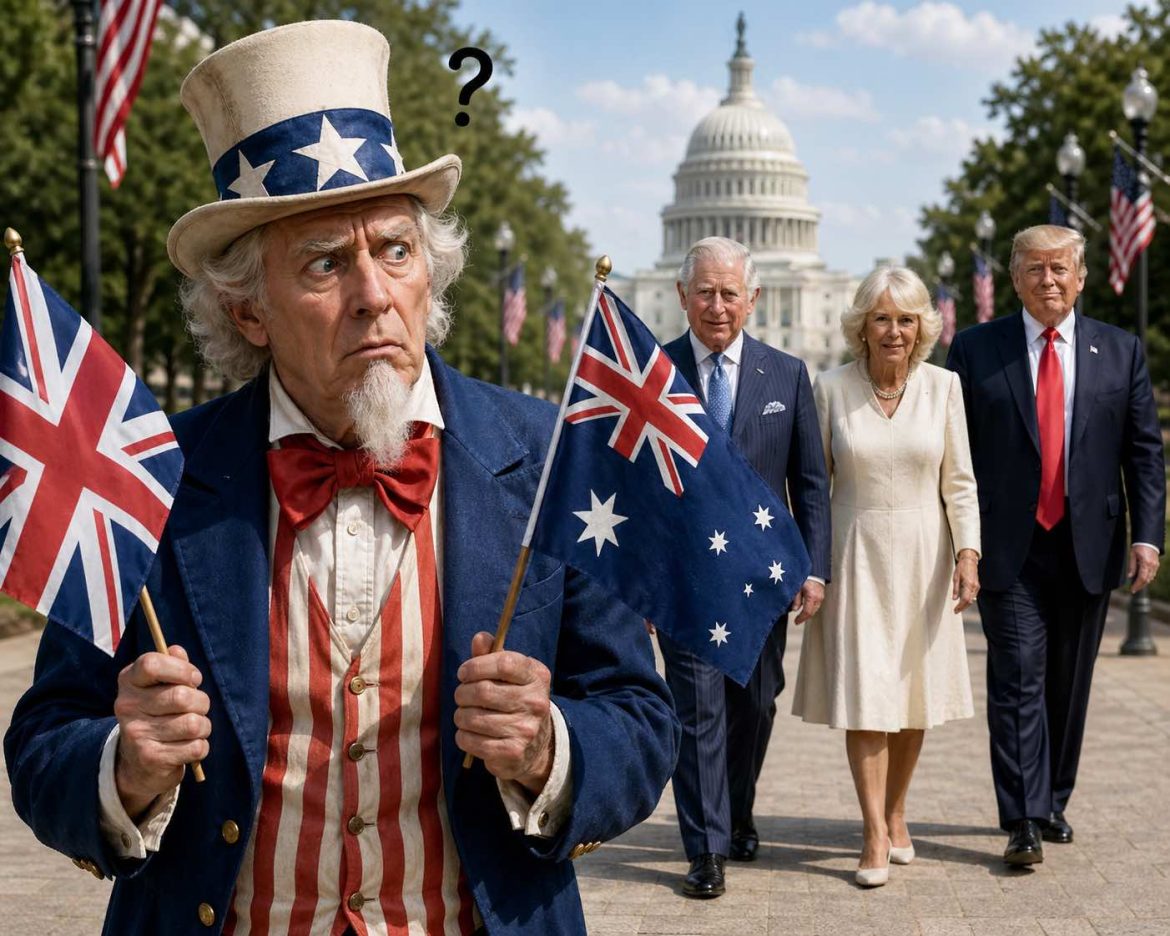
There are diplomatic slips, there are bureaucratic blunders, and then there are those rare moments when a superpower manages to hang the wrong country from its own lampposts.
Step forward, Washington, D.C.
In preparation for the visit of King Charles III and Queen Camilla, officials in the American capital decided—whether through haste, indifference, or a heroic commitment to geographical improvisation—to decorate the streets not with the Union Jack, but with the Australian flag.
Now, to be fair, this is not entirely irrational. Australia, after all, does feature the Union Jack in the corner of its flag, in much the same way that a photocopy of a masterpiece still contains traces of the original. And yes, the King is technically head of state of Australia, albeit in a role so ceremonial that it might best be described as constitutional window dressing.
But one might have thought that, when welcoming the British monarch to mark a visit freighted with historical symbolism—250 years after America declared independence from his ancestor—someone, somewhere, might have paused to check which country he actually reigns over.
Apparently not.
The error was, we are told, “quickly corrected.” This is reassuring in the same way that discovering your pilot has eventually located the correct runway is reassuring. One is grateful, certainly, but one does wonder how the confusion arose in the first place.
It is tempting—almost irresistibly so—to chalk this up as another exhibit in the long-running case study of American insularity. A nation of 330 million souls, with oceans on either side and a news cycle that rarely strays beyond its own borders, can occasionally give the impression that the rest of the world exists chiefly as a backdrop to its own domestic dramas.
This is not, in itself, a crime. Every country has its provincial tendencies. The British, after all, can be relied upon to discuss the weather in Kent with a seriousness normally reserved for geopolitical crises. The French remain convinced that Paris is the centre of civilisation, and that anything beyond the périphérique is a regrettable afterthought.
But there is a difference between parochialism and plain ignorance.
One might forgive a passing tourist for failing to distinguish between the flags of Australia and the United Kingdom. Both are blue, both feature stars, and both carry that familiar Union motif in the canton. A moment’s confusion is understandable.
What is rather less forgivable is for the capital city of the United States—seat of government, host to embassies, and self-proclaimed leader of the free world—to make the same mistake while preparing for a state visit.
This is not a school geography quiz. It is diplomacy.
The episode has, predictably, been brushed off as a minor mishap, a harmless mix-up in the grand scheme of things. And in one sense, that is true. No treaties were broken, no alliances shattered, no wars inadvertently declared (though history suggests that flags have been known to provoke such things).
Yet symbols matter. Flags, in particular, are not mere decorative accessories; they are shorthand for identity, sovereignty, and history. To display the wrong one is not just a clerical error—it is a statement, however unintended, about how seriously one takes the occasion.
And here we arrive at the uncomfortable point. The United States, for all its power and influence, sometimes betrays a curious indifference to the outside world. It is not that Americans are incapable of understanding global affairs; far from it. The country produces some of the finest diplomats, scholars, and analysts anywhere.
But the broader culture can, at times, appear strikingly incurious.
One sees it in the perennial inability to locate countries on a map, in the casual conflation of distinct cultures, and now, apparently, in the inability to tell one Commonwealth flag from another.
This is where the defence of “well, he is also King of Australia” begins to wear thin. It is the sort of argument that might satisfy a particularly inventive schoolboy, but it is scarcely a standard to which a great capital should aspire.
If anything, it makes matters worse. For it suggests not merely confusion, but a kind of lazy reasoning: a vague awareness of a connection, coupled with a complete absence of precision.
Close enough, one imagines the thought process went. Blue flag, bit of Union Jack, same monarch—what could possibly go wrong?
Quite a lot, as it turns out.
None of this is to suggest that Americans are uniquely prone to such errors. The annals of international embarrassment are replete with examples of misplayed anthems, inverted flags, and geographical howlers. Humanity, in general, is not renowned for its attention to detail.
But there is something particularly jarring about this instance, precisely because of who committed it.
When the world’s most powerful nation cannot reliably identify the flag of one of its closest allies, it invites a certain amount of gentle—indeed, irresistible—mockery.
And mockery, in diplomacy, is rarely a good look.
Still, perhaps we should be grateful for small mercies. At least Washington did not opt for the flag of New Zealand, which might have required an even more nuanced explanation. Or, heaven forbid, Canada—though one suspects the maple leaf might have been deemed insufficiently decorative for the occasion.
In the end, the episode will be forgotten, filed away among the countless minor absurdities that punctuate international relations. The correct flags will be raised, the speeches delivered, the toasts made.
But for a brief moment, at least, the capital of the United States managed to demonstrate that, in matters of basic global awareness, it is not merely fallible—it is occasionally, magnificently, wrong.
And no amount of oceanic distance can excuse that.
Click here for more News & Current Affairs at EU Today
Click here to check out EU TODAY’S SPORTS PAGE!
___________________________________________________________________________________________________________________

